Exporting tequila to the United States seems simple from the outside…
However, behind every bottle that crosses the border lies a regulatory, operational, and logistical framework that many brands underestimate.
In recent years, the growth of the tequila category in the U.S. market has prompted more companies, entrepreneurs, and private brands to seek out tequila producers in Mexico. However, many of these initiatives discover too late that exporting tequila is not simply a matter of producing a spirit and shipping it abroad.
The Reality of the Industry
In reality, exporting tequila involves complying with Mexican and international regulations, coordinating technical documentation, validating labels, and planning processes months in advance.
For this reason, many projects fail not because of the product, but because of the lack of structure behind the operation.
In this article, we explain what most brands don’t understand about exporting tequila to the United States and why working with a tequila producer in Mexico with export experience can make the difference between a smooth launch and a project fraught with friction.
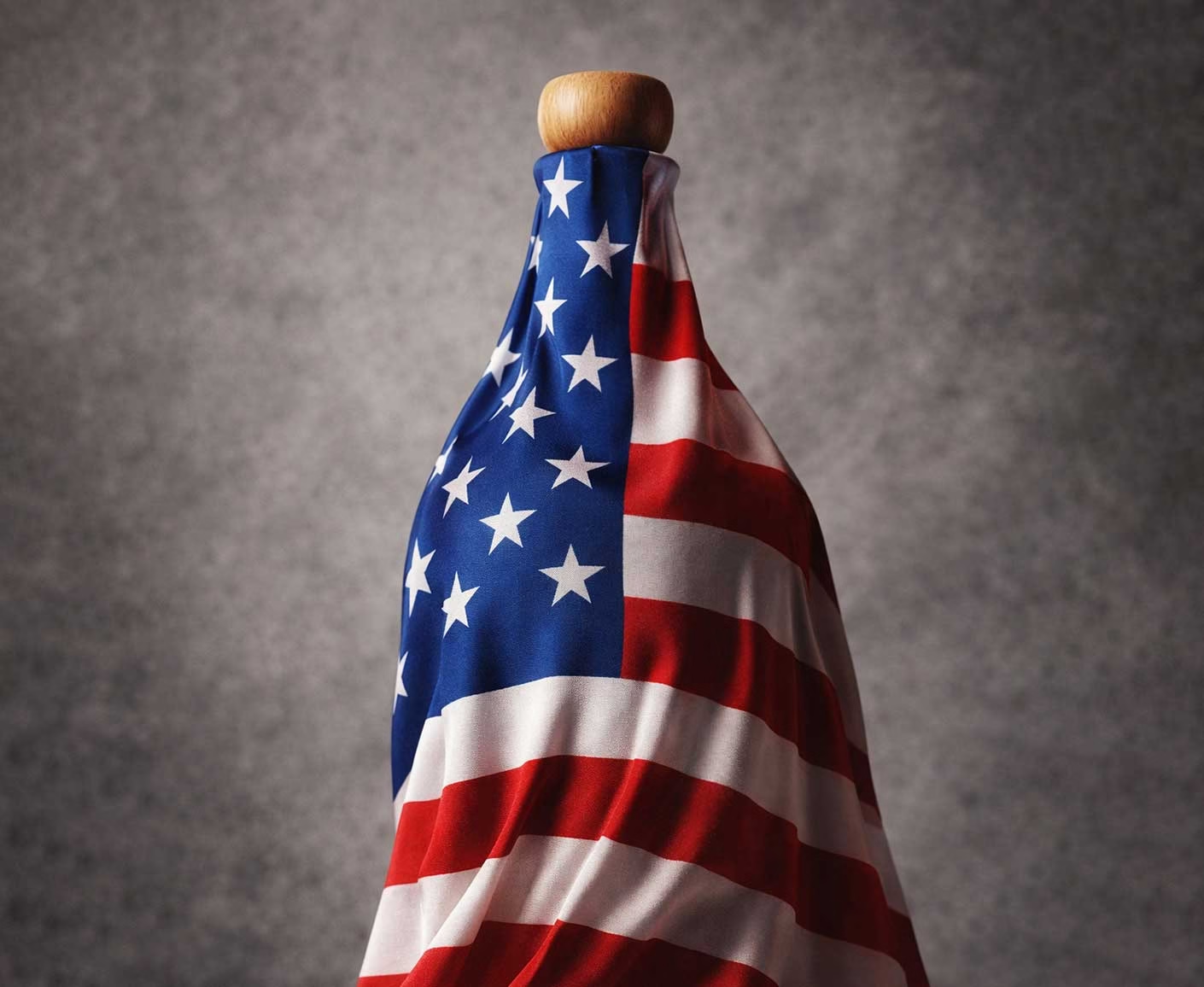
“Exporting tequila isn’t just about moving product between countries. It involves coordinating regulations, production, documentation, and international compliance.”
Exporting tequila is more complex than many brands realize
One of the most common mistakes in private-label tequila projects is assuming that the export process begins once the product is finished.
However, exporting actually begins much earlier: from production planning, regulatory validation, and document preparation.
In this regard, tequila is one of the most heavily regulated alcoholic beverages in the world. Its production is protected by a designation of origin and supervised by specific regulatory bodies in Mexico and the United States.
Therefore, exporting tequila involves coordinating elements such as:
- NOM-certified production
- CRT supervision
- Health registration and regulatory compliance
- Label approval
- Export documentation
- International logistics coordination
When any of these elements fails, the consequences often result in delays, additional costs, or even product detention at customs.
In fact, many brands discover too late that a good bottle or a strong visual identity are not enough to sustain an international project.
The regulatory system behind tequila.
-
NOM and CRT: the legal foundation of Mexican tequila
For a product to be legally called “tequila,” it must be produced in accordance with the regulations established by the Norma Oficial Mexicana or (NOM) and be supervised by the Consejo Regulador del Tequila (CRT).
The NOM defines fundamental aspects such as:
- Authorized production zone
- Permitted agave varieties
- Production methods
- Tequila classifications
- Traceability and labeling requirements
Meanwhile, the CRT ensures that production complies with these guidelines and validates the product’s authenticity for export.
This means that any brand seeking to export tequila to the United States must work with an authorized and certified producer.
Without NOM compliance, the product cannot be legally marketed as tequila.
Furthermore, without proper traceability and validated documentation, exporting becomes operationally unfeasible.
Choosing the right manufacturer makes all the difference
There are many tequila producers on the market. However, not all of them operate with the same structure or have real experience in international exporting.
For this reason, choosing a tequila manufacturer in Mexico should not be based solely on price or production capacity. You should also evaluate:
- Experience exporting to the United States
- Internal regulatory processes
- Capacity planning
- Batch traceability
- Documentation coordination
- Laboratory validation
- Technical and operational support
In fact, a well-structured manufacturer can reduce operational friction, prevent regulatory errors, and facilitate a brand’s long-term growth.
At Casa Esparza, we understand that exporting tequila requires much more than just producing a beverage. It requires structure, coordination, and operational vision from the very start of the project.
Structure defines scalability
In the tequila industry, solid projects are not distinguished solely by their image or narrative.
They are distinguished by their ability to execute correctly.
The successful export of tequila depends on multiple factors working in sync:
- Production
- Regulation
- Documentation
- Quality
- Logistics
- Planning
When these elements are aligned, brands can grow steadily and build sustainable operations for international markets.
Conversely, when the structure fails, even the most promising projects face delays, inconsistencies, and limitations on growth.
In this context, speed is rarely the competitive advantage. Structure is.
International execution begins long before exporting
Exporting tequila to the United States is not simply a matter of shipping product overseas.
As we have seen, the process involves Mexican regulations, international compliance, document approval, logistics coordination, and operational planning.
For this reason, working with a tequila producer in Mexico that has export experience can help reduce risks and build stronger projects from the start.
At Casa Esparza, we believe that successful international projects aren’t improvised. They’re structured.
Execution defines the brand
Launching a private-label tequila brand isn’t just a creative decision—it’s also an operational one. As we’ve seen, the difference between a successful tequila project and a delayed or inconsistent launch rarely lies in the brand itself. It lies in the execution behind it.
In particular, from compliance with NOM standards and production planning to batch traceability, laboratory validation, and export coordination, each stage requires structure, coordination, and foresight. For companies seeking a reliable tequila manufacturer in Mexico, understanding this process is not optional—it is essential.
In this context, this article does not aim to simplify the process, but to clarify it. Because in the tequila industry, the brands that succeed are not the ones that move the fastest, but the ones that plan the best.
Keep discovering with Casa Esparza
In upcoming articles, we will explore topics such as:
- How to obtain TTB label approval
- Common mistakes in private label tequila
- Differences between exporting tequila and other spirits
- Production planning for international brands
- How to choose a strategic partner for tequila exports to the U.S.
At Casa Esparza we believe that structured execution is what turns an idea into a scalable tequila brand.

Download our free resource for importers
As part of the planning process, one of the first operational requirements is the Certificate of Export Authenticity (CAE). We’ve put together a practical guide outlining the 3 essential steps to obtain it:
“The 3 Essential Steps to Obtaining the CAE”
A clear and straightforward document to help you understand one of the key elements of the export process.
Ideal for:
• Importers
• Distributors
• Private label brands
• Professionals who need clarity on the regulatory process
👉 Click to request it via WhatsApp and receive it directly on your device.